A diagram of a cell can show you where a receptor sits. Understanding what happens when a molecule reaches that receptor takes more explanation. You need to follow the interaction, see what changes inside the cell, and connect that change to something the cell does.
Mechanaut is an interactive 3D explorer for biology and chemistry built around that kind of explanation. It brings molecular structures and guided biological stories into the same space. You can follow a process, stop at an unfamiliar step, and inspect the parts involved before continuing.
The idea is to make the relationships easier to examine. A protein's shape becomes more meaningful when you can see where it sits and what it interacts with. A sequence of events becomes easier to follow when the objects in the explanation are still there to explore.
Looking at a structure and following a process
Mechanaut offers two ways into a subject. Models is for examining an individual structure. Cinematics is for following a process in which those structures take part.
In Models, you can browse biology and chemistry, search for a subject, and turn it around in 3D. Selecting a part connects its geometry with an explanation. Isolation and transparency let you look past surrounding material when it hides the thing you are trying to understand.
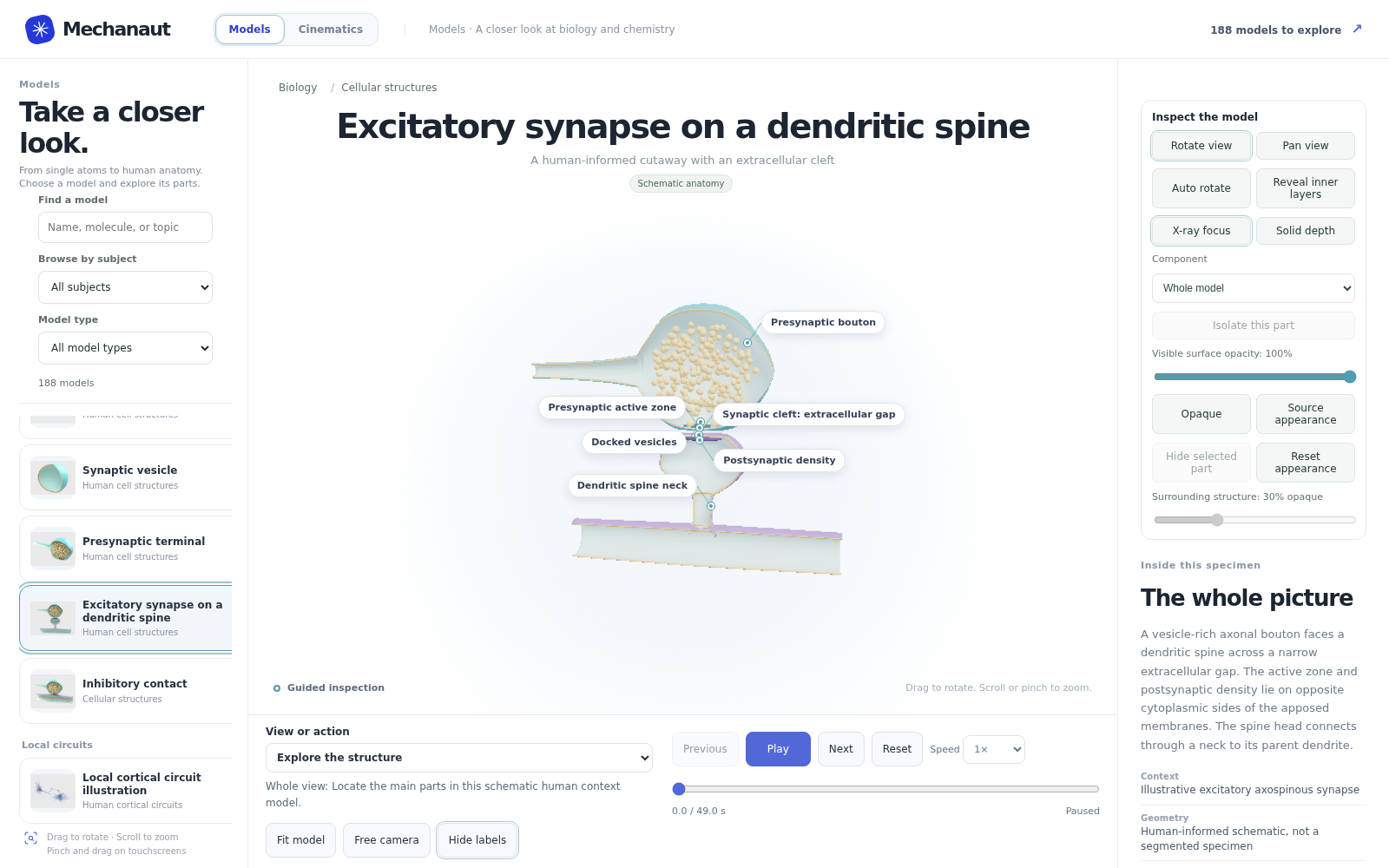
A schematic synapse in Models, with its labeled parts and inspection controls. Each screenshot opens at full size.
That freedom is useful when you have a specific question. You might want to see where a molecule fits into a larger protein, or how a component is positioned relative to a membrane. You can spend time on that detail without waiting for a presentation to reach it.
Cinematics provides a route through the subject. A guided camera, captions, and named checkpoints help connect one event to the next. The scenes remain interactive while they play, so you can change the viewpoint or pause to examine a component. You can also open a full model and return to the journey at the saved checkpoint.
The two views support different moments in learning. Sometimes you need someone to guide your attention. At other times, you need to take control of the view and work out a particular relationship yourself.
Following a message back to its sender
One journey, A receiving cell adjusts its input, gives a concrete example of the project’s approach. It follows a feedback process between nerve cells.
We often picture communication between nerve cells as an arrow from a sender to a receiver. At a synapse, the connection where this communication happens, chemical messengers released by one cell can affect another. Under some conditions, the receiving cell can release a chemical signal that acts back on the sending side.
This reverse direction is called retrograde signaling. Research on endocannabinoids, signaling molecules made within the body, has linked this feedback to reduced calcium entry and transmitter release at particular synapses. The experiments concern defined cellular systems, rather than a prediction of an entire brain's activity. Read the experimental study.
Mechanaut turns that explanation into a sequence you can follow spatially. The scene establishes the sending and receiving cells, follows the returning message, and connects a receptor in the membrane to the machinery on its inner side. The explanation then returns to the connection between the cells to show the local consequence.
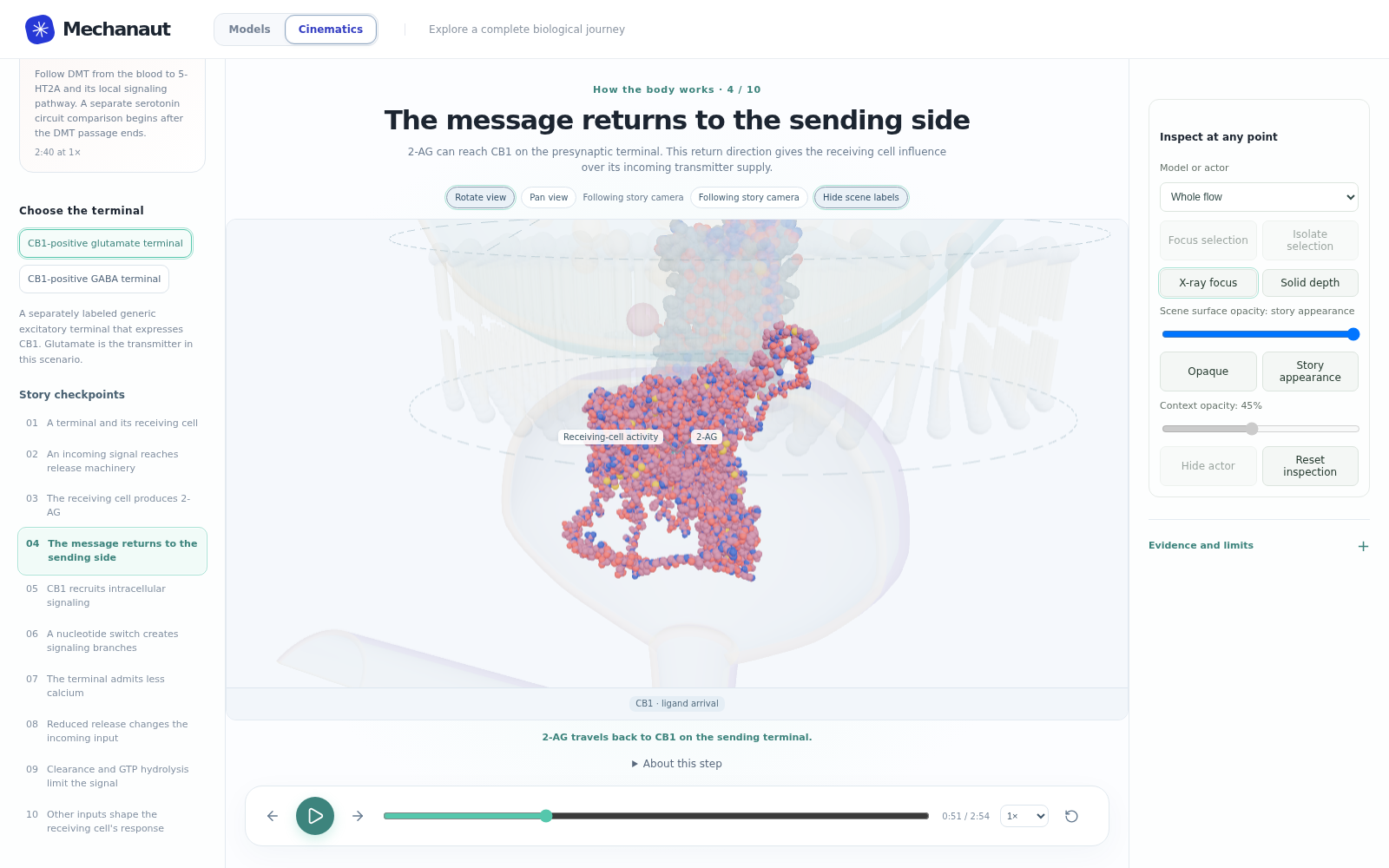
The returning-signal checkpoint connects the molecular view to the surrounding cell geometry and the sequence of events.
A learner can pause at the receptor and inspect it. Someone else may want to replay the opening to understand why the message is traveling backward. Both questions belong to the same story, but they call for different views and different amounts of time.
The scene also follows how the signal is limited and cleared. Ending there gives the process a more useful shape: an event has a starting condition, a consequence, and mechanisms that limit its duration.
Moving between scales without losing the story
Biological explanations often move between objects of very different sizes. A cell gives the setting for a process; a protein or a small molecule may explain an individual step. Showing both at once can make the smaller structure difficult to see.
Mechanaut's design uses changes in viewpoint and representation to connect those scales. A wider view explains where an event belongs. A close view lets you examine the component involved. Labels and surrounding structures help keep the detail attached to the larger process.
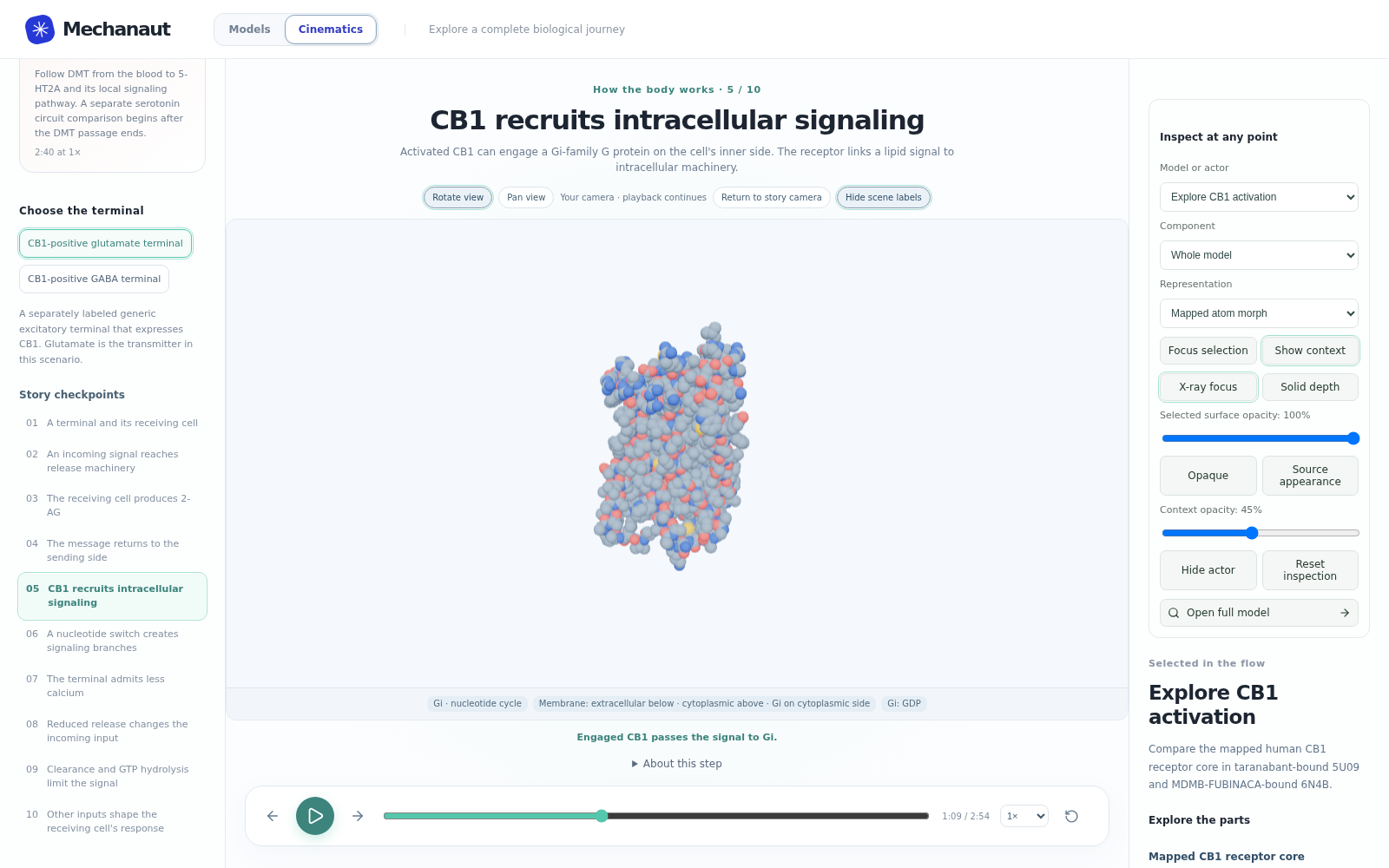
Selecting and isolating CB1 brings the receptor into focus while the story checkpoint remains available.
The same principle applies beyond nerve-cell communication. The project's journeys explore energy production and use, as well as molecular signaling. Each subject calls for an explanation that connects the participating structures with the sequence of events.
More visual detail is useful when it answers a question. If every surrounding object is equally prominent, the viewer has to search for the action. Isolation, opacity, and guided framing let the explanation concentrate on a particular interaction while keeping its context available.
Keeping the evidence visible
A convincing animation makes choices that deserve explanation. The structure of a protein, the timing of an event, and the path drawn for a moving molecule can come from different kinds of evidence.
Mechanaut uses structural references alongside computed geometry and schematic biological context. For example, the CB1 receptor structure in the Protein Data Bank provides a reference for molecular shape. An animated journey that uses a receptor model still needs separate evidence for its biological explanation and separate choices about how to present it.
A camera path guides attention. A slowed-down movement makes a step easier to inspect. A simplified membrane helps establish which side a component occupies. These are decisions about teaching and presentation; they should remain distinguishable from experimentally measured structure or motion.
The interface keeps source notes and explanations of the depiction available alongside the scene. You can follow the story first, then look more closely at the basis for a structure or the limits of an animation. That makes the model useful as something to question and examine.
Letting the learner set the pace
The experience I want from Mechanaut is one where curiosity can interrupt the presentation. If a label introduces an unfamiliar protein, you should be able to stop, inspect it, and find out what role it plays before moving on.
That changes how a visual explanation can be used. A student can revisit one confusing step. An educator can stay with a particular interaction while explaining it. A reader already familiar with the mechanism can spend more time examining the structures behind it.
Papers provide the evidence, and textbooks organize a subject into an explanation. Mechanaut gives that explanation a space you can move through. Follow a message across a cell membrane, pause at the receptor, and turn the model until the relationship you were trying to picture becomes visible.